Inner Gothic Teen Comes Out

I’ve been reading Clarissa Pinkola Estes “Untie the Strong Woman,” the chapter where she talks about working with teenage girls in prison.  She called them her “Blackbirds.”  I wonder about a part of me that’s an angry and defiant teenager.  I remember giving her some space when we were doing Journey into Courage.  I drove Dana’s small white sports car with the windows open and the sound track from Thelma & Louise on the tape deck with the volume turned up loud.  Maybe that’s the part of me that’s my shadow: angry at me for being such a goody-goody, wanting to wear heavy makeup and sexy clothes, or defiant clothes, black, ragged, tight — and tattoos.  What would I have for a tattoo?  Kali.  This part of me is angry at me, she’s angry at the culture, she’s angry at Mother.  I always thought I couldn’t do that — especially the lots of makeup — because I wasn’t beautiful, but you don’t need to be beautiful to be defiant.  To find ways to give voice to that anger, rebellious anger — but I do!  I do it all the time, posting things on Facebook and writing angry comments with them.  Maybe it’s the energy of anger I need to fuel my struggle with apathy.

jenny 10:31

I’ve puzzled over my “shadow” because that’s the part of me I’ve rejected, don’t acknowledge as part of me, according to Jung.  Most of my shadow is positive, my creativity, my passionate caring about many things.  Mother made me so wrong for being creative (“making a mess”), for talking with enthusiasm about something I was interested in (“thinking you’re so great”), for being happy and spontaneous when she was depressed, etc.  So of course I hid those parts and thought I wasn’t creative, etc.  I’ve been a long time learning that those parts of me are good and should be allowed to appear in my life.

But now I’m thinking of this other shadow who wears heavy makeup, dyes her hair black, wears black ragged clothing, hi-top shoes.  Tattoos?  Jewelry?  Something clunky, lots of chains.

I wonder what I’d look like with black hair?  Probably awful.  I could do it for Halloween, black clothes and boots, go to the Halloween bonfire.

jennysmilecolor

I got fired-up, got temporary hair dye, gel, fake nose rings, black lipstick.  It was really fun dressing up.  I went to the church first — they have candy, veggies & dip, fruit and hot cider.  A place for people when they’re tired and cold.  Surprise!  Everybody thought I looked great, especially my hair.  I asked Barry if I should come to church in costume and he said “Yes!”  I asked Victoria if I could wear it to sing in the choir and she said “Yes!”  OK.  You asked for it.  So I showed up in costume.  Again I thought some people would criticize, I suppose if they did it wasn’t to my face, and I had a lot of fun.

Posted in Activism, Present Day | Comments Off on Inner Gothic Teen Comes Out

Breakdown in Davis

I’ve mentioned the breakdown in Davis more than once, but never told the whole story.  My good friend Kathi moved to Davis to go to Nursing School, and I followed her.  The environmental movement was just gearing up — it was 1970 — and I was invited to be part of a team that was exploring computer modeling of biological systems.  I could have had a career in the growing environmental movement.  I remember Dr. Watt saying of my Wellesley degree, “They taught you how to think.”  He also saw that I was admitted to the University of California at Davis.

It was all too much for me.  I got overwhelmed, got into another bad relationship in my desperate search for security, and finally had a breakdown that landed me in the University Health Center.

That breakdown actually happened because I was seeing a psychiatrist.  He asked me about my childhood.  He said “You must have been very frightened.”  That blew something wide open.

Journal entry January 25, 1970

work with Dr. Asher: realized that from a very early age i was somehow given the message that I was not to trouble my parents with my problems but was expected to hide them, weep in secret, somehow solve them myself.  His questions brought out my own role as mother in the family, as parent to myself and to my brothers and sisters.  Then he said a strange thing “You must have been very frightened.”

When I left his office I was exhausted, as though i had spent an hour of hard physical labor.  i slept for nearly 24 hours after that — a sign of a breakthrough.  strong feelings of confession and absolution. what was it? perhaps for the first time having real pride in my real accomplishments — somehow having been a parent without parental example — and it was real pride instead of inflated-ego-neurotic-martyr-pride.  His statement about being frightened:— i had paid the price for my “pride” in daring to assume my parents role; and it was all right to be frightened — it was all right to be frightened!  it wasn’t a great sin, it was a perfectly normal childhood reaction to such a responsibility.   had always put myself down for being frightened, and let my life be largely controlled by fear because i never learned that it was a normal reaction which could be faced and dealt with.

Reading this now, I’m a little amused at my adolescent language.  One thing I notice, though, is that I say “daring to assume my parents’ role”  No, I didn’t “dare” or “assume,” the role of parent was dropped on me by their failure to be parents.  My astonishment finding out that it was “all right to be frightened” tells me how many times I was made wrong for being afraid.  Or else it was just ignored instead of dealt with.

I think up to that point I had been in denial of my fear.  The “fear” I said controlled me was fear of making a mistake.  It wasn’t anything like the cold terror I experienced the next winter in Maine.  Possibly I was in denial of all my feelings.  I had been mostly living in my head.  The first thing I felt after my fear was validated was anger.  Giving expression to the anger opened me wide up.  I was scared enough to put myself in the Health Center and take the tranquilizers they offered me to try to close myself down again.

The rest of the story.  Dr. Asher said “You must have been very frightened.”  I remember feeling absolved.  I wrote “It was OK to be frightened!”  I slept almost a whole day.  Then I decided to put my life back together without David, but I wanted to borrow his truck to get a door to make a desktop.  When I got to his apartment, he wouldn’t let me in, and I could see another girl.  So I got my car jack and started smashing his windows.  Then the cops came.  I knew David wouldn’t want them involved.  He was dealing drugs, which I carefully stayed in denial of, so he told the cops he wouldn’t press charges.  Feeling totally lost, I went to my friend Kathi and told her what I’d done.  She said “But Jenny, you can’t do that.”  So I went to the student Health Center and turned myself in.  I was exploding with rage at being abandoned, but I had no idea and neither did the staff or anyone around me.  I must have appeared manic.  I know I wrote and wrote in my journal — there was something I called “Notes from the Hospital” and my regular journal which I had named Ondine, following Anaïs Nin, my current role model.  They were giving me Mellaril, a powerful tranquilizer, 300mg a day.  Later, working on a crisis hot line, I found out that 600mg was the minimum lethal dose.  It was a good thing I didn’t know that.  I had heard a story about someone who tried to kill himself with tranquilizers and didn’t die, just was very tranquil for a while.  I hated the way Mellaril made me feel.  Very slow and sort of blurred.  When I got out of the hospital, I got off it as quickly as I could.  Withdrawal was very uncomfortable.  I didn’t see “pink elephants” but I understood what they meant.

After that, I never experienced the rage again.  I wish there had been someone at the time who knew something about trauma.  But Peter Levine’s book was 30 years in the future.  I did, however, start to feel fear which I don’t remember feeling that intensely before.  It was as though Dr. Asher had given me permission to feel fear.

UPDATE from 2019:  I looked up Mellaril only to find out that it is an anti-psychotic, not a tranquilizer.  It was a good thing I didn’t know that.  I actually had a lethal amount in my possession for several years after I stopped taking it.  But I had heard of someone who took a whole bottle of tranquilizers, and didn’t die, just got very tranquil.  I only found out that twice the dose I was taking was the minimum lethal dose when I was working on a suicide hotline in 1974, and I’d gotten rid of it long ago.

Posted in Breakdown, Journal, Trauma | Comments Off on Breakdown in Davis

New Dog?

I am thinking about getting a rescue dog.  He was in a situation where the owner had more dogs than they could care for.  He probably wasn’t let out of his crate very often.  He isn’t house trained and is scared to go outside.  He is very timid and fearful.  My heart goes out to him, but I’m not sure how much work he will be for me.

damien

Dialog with Baby Jenny about getting Damien:

How are you doing?

I’m a little worried and scared.  All your energy is going toward the dog.

That’s true.  I’m sorry.  Let me make the effort to come to you, because I do care about you, and you are number one in my heart.

Better than Lynelle?

Yes.

better than Beverly?

Yes.  I apologize that I have a long old habit of turning away from you, not wanting to feel your pain, not valuing you as my mother didn’t value me.  But I have learned to value you, and care about you, and I’m glad you’re in my life.  And we have help because Erica loves both of us.  I do love you.  You are creative and generous and loving.  You began to doubt these things because your mother couldn’t receive them, or even trivialized them.  You deserved better than that.

I did?

YES.  And it wasn’t your fault that she treated you that way.  She was an alcoholic, and a narcissist, and probably depressed, and she couldn’t respond to you.  Now you have Erica who responds with enthusiasm.  I know you don’t quite trust her yet, but I do.  I will hold you and keep you safe until you can trust her too.

I think the thing I’m most scared about is I will meet Damien and not want him.  Or I will meet him and just not know.

What do you think Baby Jenny?

I feel more comfortable with Damien because he’s scared.  I know all about being scared.  I think if you got a dog who was big and affectionate, that I’d feel scared that you’d love him better than me.

Thank you, Baby Jenny.  What do you need now?

A cuddle.

So we cuddled for a while with Muffy.

Posted in Depression, Present Day, Trauma | Comments Off on New Dog?

“I was in trouble and nobody noticed”

Last month I had a bad headache and Lynelle asked me what I was feeling.  I said “Nothing” so she asked what the baby was feeling.  I tuned in and got the words “angry” and “stuck.”  Later I asked the baby why she was angry and she said “I was in so much trouble and no one saw it!”  Well no wonder she was angry.

I thought about all the times that someone knowledgeable would have started suspecting something was wrong.  But back in the 40’s and 50’s no one knew about child abuse, teachers were not taught what to look for.  They wouldn’t have known what bruises meant, maybe that the child had fallen.  In my case, though my parents were alcoholic, they weren’t violent.  Even I didn’t know how much they had damaged me until the knowledge about “Children of Alcoholics” began to be public, and that wasn’t until 1984.  On that list is “over-achieve in school.”  A sensitive and knowledgeable teacher might have been able to suspect that my “good behavior” was because I was scared.  Though it was also true that I loved school.  I was lucky to be in a private school with excellent teachers.  I was intelligent and wanted to learn, and I had the learning style that schooling was designed for.  I felt safe because the rules were clear, not changing all the time, and there was clear, accurate and consistent feedback in the form of grades.

The baby is angry because she was in so much trouble and no one saw it.  Or if they did, they didn’t know what to do.  My cousin Susan told me a story several years ago, that her father had only told her recently.  He had gone to my house for some reason, couldn’t find my mother (who was probably unconscious upstairs) and found me climbing on the kitchen counter, trying to feed my younger siblings.  I’m sure he was concerned, but those were the days when you didn’t interfere.  There was the time I went down to the end of the driveway because no one was at home and Herman, my grandfather’s groom, rescued me.  My Aunt Betty, who was the most psychologically sophisticated member of my family, told me about a time when she had come over and found me alone in a playpen, clearly unhappy.  I’m sure she was concerned at the time, but didn’t know what to do, or if there was reason to interfere until much later when she went into therapy herself.  There was the time my classmates Ann Minor and Boots Thompson made me drink a doll’s bottle with a rubber nipple full of salt water and put me in a baby carriage.  We must have been visiting their parents, and the adults weren’t paying attention to what the children were doing.  I couldn’t stand up for myself and stop them.  I think I felt helpless, rather than angry.  The Black maid rescued me.  In 4th grade, when they were having us all do the eye test, I couldn’t see the letters.  Other kids laughed at me.  The teacher sent me home with a message to my parents.  That might have been a time that someone might have suspected that I was being neglected.  But I was intelligent and well-behaved and quiet, so no one understood that I was in trouble.

In my junior year at college, when I started falling asleep over my homework, they put me in the health center, they thought I had mono.  But I didn’t, there was nothing physical wrong with me.  Nobody thought to bring in a psychologist.  At the Health Center in Davis, I had broken apart emotionally, so they all tried to put me back together, shut the genie back in the bottle — I was scared enough that I wanted it shut down too.  They were giving me 300mg of mellaril, a powerful tranquilizer.  Later I found out that 600mg was the minimum lethal dose.  It was a good thing I didn’t know that at the time.  I wonder if it happened today if someone would recognize PTSD?  Probably not.  Nor did anyone see it as a potential for opening a piece of work in therapy.  If I had had someone to work with me with Somatic Experiencing, I might have been able to heal a lot way back then.  But Somatic Experiencing wasn’t even developed until almost 30 years later.

I talk about my breakdown in Davis toward the end of another post.

When I was on my own, because I had an independent income I didn’t have to work.  So I wasn’t at a job where people might notice if I didn’t come to work for a few days, or burst into tears occasionally, or had a full-blown nervous breakdown.  But I was hanging out with hippies, smoking pot occasionally, and questioning everything.  After the failure of a relationship I retreated back to the East Coast, and began a long struggle with severe depression.  I had no idea what it was, just something else wrong with me.

I used to feel guilty for the luxury of not having to have a job.  What I didn’t know, until I began to work with PTSD, was that I would never have been able to work a 40-hour week.  If I had not had an independent income, I would probably be in a mental hospital, or dead.

Posted in Trauma | Comments Off on “I was in trouble and nobody noticed”

The Descent into Hell

This piece is from a retreat I did with Deena on Martha’s Vineyard in September 1998.  Deena was using as a theme of the story of Psyche and Eros.  The descent into the Underworld is part of Psyche’s story.  I am describing my experience of the “Summer from Hell,” the summer of 1996, when I was terrified out of my mind.  I never slept more than ninety minutes at a time, would wake terrified in a sweat, somehow manage to sleep again, and wake again in ninety minutes…  I lost a lot of weight, I was down to 105lbs.  By 1998 I was on antidepressant medication and it was working somewhat, at least I wasn’t terrified any more, but I still had trouble sleeping.

The Descent into Hell

My life is getting drier and drier, grayer and grayer, all the juice is running out, has never been.  Step by step through the rain of ash, the bitter fog, the deepening cold.  Step by step.  Now put your right foot forward…

I wake in terror.  I get out of bed because it’s just as scary to stay there, and sometimes things are better if I move.  I do yoga because it’s something for my mind to cling to.  I have a sequence of postures written down because it’s too hard to decide what to do next.  I eat breakfast, forcing tasteless food against the dryness in my mouth.  I wash dishes because it’s something I can do and something that must be done, and it gives me an illusion of being effective, having a purpose.  I lift a spoon out of the water, resist the impulse to scrub it quickly and move on — because what do I have to do today, nothing important, nothing worthwhile, nothing that would save the world or “do good for others” — there isn’t anything I can do that would make me feel better, would still the panic, would give me the sense that there might be something that I could do “right”, something that would placate the angry goddess who has never been happy with me.  So if there’s nothing I can do, I might as well be doing the dishes, putting off the awful moment when I will have to decide what to do next.  I scrub the spoon slowly, saying in my mind “This too is God.”  I try to scrub it gently, reverently, with my anxiety-stiffened fingers.  I notice the sun glittering on the dishwater, the chickadee in the apple tree, the snow on the mountain.  I know that at some other time, on some other planet, these things are beautiful.  There is no beauty now, no peace, no silence, no warmth.  When I have finished the dishes the next thing is to water the plants.  I pour spring water from the hose into the watering can.  I notice how the stream of water spirals with silver glints inside, how it follows a trajectory without being either rigid or sloppy.  As I pour the water on to the plants, I hold on to the silver spiral glint as a drowning person holds on to a rope she hopes might lead her to the surface.

Posted in Depression, Story, Trauma | Comments Off on The Descent into Hell

Left-Hand Writing

To explain “left-hand writing.”  It was after I’d learned in dream group about the major archetypes: sun and moon, right hand and left hand, linear & logical and intuitive & associative (also called “right-brain”) …  I don’t like to use the hemispheres of the brain because that may be an anatomical truth, that the right brain controls the left side of the body and speaks more in images than in words, but human experience is that the left side of the body is intuitive, etc.  If you go to the left in a dream, you are heading toward right-brain experience.

I don’t remember now if I started “left-hand writing” before I imagined the book with right and left pages.  Certainly they were close together.  I didn’t literally write with my left hand, when I tried the words came faster than I could set them down.  So I would “tune in” to that other side of myself and take dictation.  Often they started one word at a time.  Sometimes they were nonsense (well of course they are non sense by definition) sometimes I had to write down through what I called the “peanut butter” stage, where you’re writing garbage, or something like “I can’t think what to say, I can’t think what to say, I can’t…” and then something breaks and the real writing comes pouring out.  Often the shift begins with “and what I really want to say is…”  I think this is the first left-hand writing I ever did.

the way of the left hand
no date by any calendar. the wave rises like sap in my
blood, rising, shredding, dividing, lifting and golden.
my spirit rooted in earth, my spirit springing to the
darkest blue night unfolding leaves filled with stars.
gulls soar above harbor, drifting & turning, my hair
floats like seaweed above the beds of the dead encrusted
with pearl lattice work. is this the body? with all these
spaces inside? like a sponge, like branching veins, like
streams braiding in sand, flow outward and let go.
drop the burdens of the journey. one. word. at. a.
time. when to genuflect and when to leap in ecstatic
dance.  for the true neck lace is of shells and the dry
bones murmur for this were crystals created. space,
and cells, letters coming evenly from the pen and
letters divinely inspired wreathed in organic flame and the
threads spiral, twist, interweave — the endless knot
the celtic dance — our feet tread the maze and body
moving body becomes the path ways by which the
mind changes gear and comes to the chalice
o holy palace     o wholly place
deep roots sunk to the springs rising
let flow now

The Feminine of History is Mystery, opposite righthand page 76

Posted in Writing | Comments Off on Left-Hand Writing

Writing the Real Story

I’ve been rereading Writing for Your Life, and I wanted to find some things I had written, either inspired by the book or written in workshops with Deena.  I went looking for the material and have already posted some of it.

Written this morning:

That was exciting, to find the material from the Deena Workshops and Retreats.  Rereading Writing for Your Life opened up something, a desire to write that way again and a fear that I can’t do that anymore.  I posted the 5-minute autobiographies.  I read through all I had written.  There were several pieces on a page I had apparently given to Deena.  I read through part of the booklet of writings of participants in the week-long retreat at Martha’s Vineyard.  It was overwhelming.  God bless Lynelle, she helped me see the connection between the headache, which started as I was reading, and excitement and fear about the writing.  When I started talking about the writing, the headache began to fade.  I also read her the 5-minute autobiographies.  She thought they were powerful.

I’ve been feeling stifled and frustrated that I haven’t been able to even get up into my studio and think/imagine about painting.  I’ve lately done only a little bit of work on my box of stories.  I did start the clay project, but there’s more work there before I can begin making figures.

Last night, Lynelle asked for my feelings to see if there was a homeopathic remedy for the headache.  I said “Exploding” and then saw the image I’d seen before after some work with Erica — maybe I should paint it! — an image of multicolored stuff pushing upward and starting to open, a little like a plant or a flower except that the pieces were all squashed together.  There was a sense that they had been cut up, cut off, cut down! pressed together — yes, there was trying to hide them, cut them off, push them down — and now they are getting out, the genie is getting out of the bottle, the baby is waking up and she’s too big for the box they tried to put her in.

Deena talks about writing the story under the story, the real story, not the one we tell ourselves, or others tell about us.  In the 3 autobiographies I see this progression.  The surface story has changed, there’s pain there now because we got divorced a few years later, and I thought he would still be my friend but he just cut me off.  That was more painful than the divorce.

The third piece clearly speaks to the PTSD I didn’t know about yet, volcanoes and bitter craters.  Trees won’t grow here for a while yet — because the hard volcanic rock has to be broken up, broken down, aged and weathered, eaten by lichen, pierced by roots, and finally, ages and ages hence, become soil that can support a plant as big as a tree.  I’ve been told that volcanic soil is very fertile.

Other writings from a similar source:
Awakening Kali
The Truth Express
Ereshkigal

Posted in Healing, Writing | Comments Off on Writing the Real Story

5-Minute Autobiographies

I’ve been rereading Deena Metzger‘s book Writing for Your Life, and was reminded of all the writing I had done with her in two workshops at Rowe and two week-long retreats.  The 5-minute autobiography is one of her assignments.  These were written in 1996, before I knew about PTSD.

I was born to alcoholic parents.  I should have been an artist, but they needed a baby sitter and the artist’s temperament was too much for their fragile egos.  I was left alone a lot, I had to figure out how to do my life in isolation, I wasn’t very good at it.  But I did learn how to do friendship, I have good friends, intimate friends, not many, but as many as I can keep up with at the level at which I like to do friendship.  I was smart enough to marry a person who was capable of becoming my best friend and teaching him how to do it.  Now I’m trying to learn how to let the artist live in my life, to give her the chance she never had.  It’s like being pregnant with a whale, or some dark watery creature who speaks a completely different language.  I’m having to move very slowly, be very patient, wait a lot, be content to be silent.

Second Round

The “out takes”: I was nuts.  I was a rebel gypsy Bohemian.  I tore up the napkins at school and left little pieces under the table and the teachers got upset about it.  I had a nervous breakdown at college, but they didn’t call it that: I started sleeping over my homework and went into the infirmary for three weeks.  I was hospitalized while I was in California.  I lost it when my boyfriend left me without a word, just disappeared, and I went to his house and started smashing his windows.  At the Health Center they were all afraid I was going to commit suicide, they filled me full of tranquilizers but I kept trying to go to class.  It was the spring of Kent State and I stuffed the genie back into the bottle, came back east and went into a suicidal depression.  Only many years later did I discover that my behavior was the legacy of my parents’ alcoholism and being sexually abused in my childhood.

— And what I really want to say is … — o yes I was inspired by Deena’s 5 minute left-hand writing (she calls it automatic writing) autobiography.  what stands out?  Blood — words written in blood and pinned to the curtain.  Overcharge  supercharge  cut into the rock and blood will flow like ink.  Passion, passion for the truth.  to follow the trail of the wily red fox.  and then write until words spray out of your ears and the pen burns the paper  cataracts and smoking volcanoes.  Something moves in the depths and whole planets get lost in the boiling flow.  Volcanoes.  Molten rock from the depths.  Where does all this lead — is this my life?  emerging molten from the depths?  Splashing red across a landscape of bitter craters.  Trees won’t grow here for a while yet.

Posted in Story, Writing | Comments Off on 5-Minute Autobiographies

Muffy

muffy

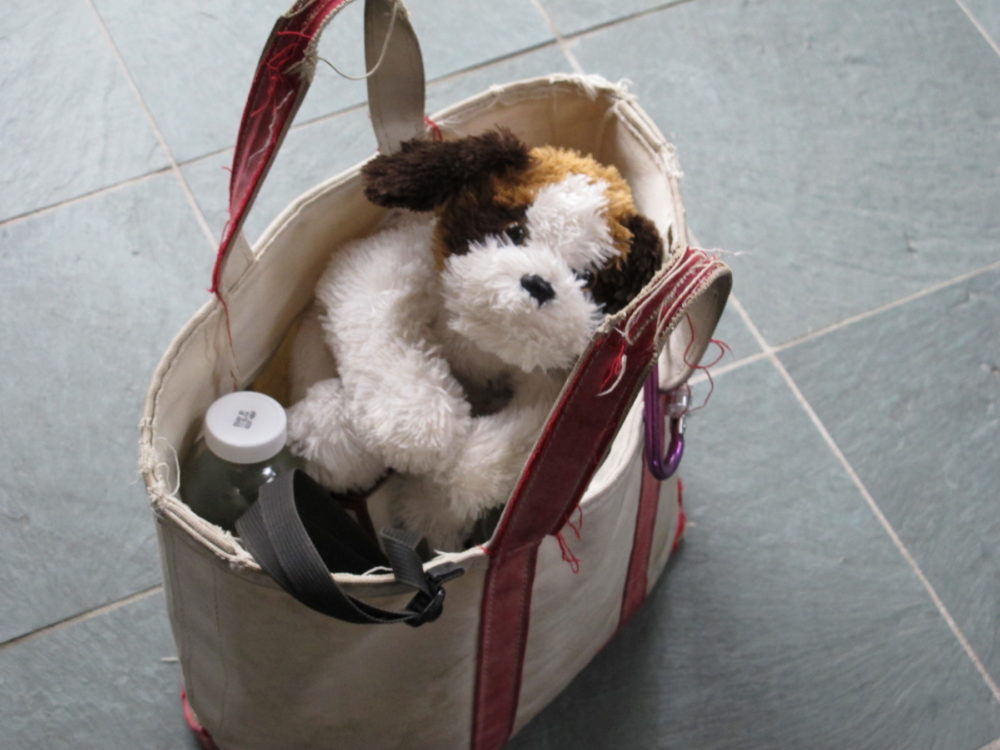
Muffy is a little stuffed dog I bought when missing Bella got to be too much for me.  He is a “transitional object,” like the “security blanket” a child uses when she is learning that she’s apart from her mother, an individual who will have to take care of herself.  If her mother is loving, she will create an internal loving mother which will give her a firm foundation for building a life.  If her mother is not loving, or disabled in some way (by depression, say, or alcoholism) then she will internalize a critical judge or a destructive inner voice.

It’s astonishing how real Muffy has become to me.  I only show him to close friends who understand what my life is like.  I take him to therapy sessions.  When I’m sitting in Erica’s waiting room, he’s hidden in my bag.  I try to make sure he’s comfortable when I put him in the bag.  When I’m in need of reassurance, I grab him and hug him.  He’s a big help.

muffy2

Because I’m working on infancy issues with Erica, and because my mother left me alone too often and for too long, I’m experiencing with Muffy the same thing small children experience with their “security blanket.”  It’s a normal healthy thing for a child to do when they are learning that they are not one with the mother but an individual.  In my case, I never really felt connected to my mother, so I’m having to re-do this part of my development.  I hope I will be able to internalize a loving supportive caretaker.

The received wisdom in the 40’s was that a mother was supposed to leave the baby to cry, instead of picking her up every time.  This would keep her from becoming “spoiled.”  Mother was alone with me (my father was away fighting WWII) and she was really not prepared for the 24/7 needs of a baby.  So it was convenient to leave me to cry.

The other thing I’m experiencing that a baby experiences when it’s left alone is apathy.  This has been getting harder.  During the summer I had two projects: the Box of Stories, and this blog.  Now I seem to be apathetic most of the time except when I’m with people.  This is why someone doing this work should ideally have 3 appointments per week.

Posted in Healing, Present Day, Trauma | Comments Off on Muffy

October Sadness

So sad yesterday.  Missing Bella, missing Erica if truth be told, and mourning for all the other wounds opened up.  October in the rain, tho it wasn’t raining, just grey.

Met Lynelle in Hunger Mountain Co-op in Montpelier.  I’d picked up a few things for supper, and was trying to figure out if I should get anything more, when I saw Lynelle in the produce section.  I helped test what she’d got, and then — I’m sure she sensed something — she asked how I was and I said “I’m lost” and started to cry.  She took charge, made me leave, said go sit in Karen’s office and write.  So I left.

Karen was a big help.  I cried and cried.  I said I had spent my whole life trying to heal and never got any of the satisfactions of real life.  She reminded me that there was Neskaya, that I did have good times dancing.  I didn’t want to hear it.  I saw my life as narrow and full of loss.  I think I just needed to mourn, to honor the sadness.  Then I talked about how she had said I was “worthwhile,” and Erica had said I was “extraordinary,” and surely if that were true I should have had a better life.  Karen said that for a person who is aware and sensitive, our culture is toxic.  A person who is “extraordinary” in these ways is not supported by the culture, more likely to be trashed by its insensitivity and violence.  I saw the truth in what she was saying, I saw that it was painful not to be able to offer my gifts to the world in some bigger way.  But it’s not due to weakness or lack of persistence as I usually tell myself.  I’ve tried again and again and been disappointed again and again.  I see that that’s something to mourn for.  And I see that I HAVE been persistent, trying again and again in spite of disappointment.

Today I see that part of why I was “lost” and having a hard time, was that “worthwhile” and “extraordinary” were totally opposed to the person mother taught me I was: somebody selfish, conceited, not thoughtful, too sensitive (as though I acted sensitive to get special treatment), etc.  This fit much better with my identity as a failure, a coward, and a weakling, names which I often called myself in my journal.  The idea that I might be someone who was actually valuable was scary and disorienting.  I did manage to wonder how my life would change if I believed that I was “worthwhile” and “extraordinary.”  I wouldn’t be so scared of making a mistake, I’d trust myself more, I’d relax and do what came naturally.

The foliage is at a new state.  Driving across Vermont, the flaming reds and green are gone, and there’s a more muted golden tone to the later leaves — oak and beech — that glow against the grey of the empty branches.

Posted in Journal, Present Day | Comments Off on October Sadness