
Conversation with God (on a retreat with Deena Metzger, August 1996)
On the New Moon, we celebrated the Feast of Hecate. Deena asked us to find something to represent a seed, to fill with our visions for the future, and then plant as a seed of a new beginning. I found a lovely little golden shell, like a translucent bubble. I had been walking along the beach talking to God and crying out how difficult this passage was, and when would it be over. The voice said “You will always be doing this work. But — it gets easier.” At that moment I saw the shell embedded in a drift of seaweed and knew it was to be my seed.
The next day I went to the beach again, hoping to find another shell like the one I buried. I looked and looked, especially in the seaweed, but found nothing. Then I decided I should stop looking for what I had found before and take what was offered. Still nothing appeared. Finally I remembered that I had been talking to God when I found the other one, so I started talking to God — it was hard to make the switch from searching, felt like giving up all hope of ever finding anything — but the first thing my eye fell on was something that didn’t look like a regular seashell. I picked it up and it was something like the other one, translucent, irregular. I found several more — they follow no form, no two alike, some flat, some cupped, more or less translucent, color from white to yellow to orange, some have barnacles or seaweed attached. After I found the first few, I considered going back to where I had buried the one I found yesterday and making a switch because that one was so much more beautiful, but I decided that when you plant a seed, you don’t get it back. Unwilling to stop with just a few, I kept looking. I said to God, somewhat apologetically, that I was being very greedy. God answered with more shells. I thought about how God had said “It will get easier” and found another one. I rejoiced in what was becoming a sizable harvest, but again felt an ache in my heart for the one I had buried. No, you can’t have it back again, not that unique, irreplaceable moment. Other moments will come, with their own beauty, but never that one again. Then I found a shell that was equally as beautiful though very different, and soon afterward a small orange one that also satisfied my heart. By this time my hand was full, I was having trouble piling more on. I thought perhaps I even had enough to give them away to the women in the retreat. (In fact I had thirty-six, but the moment to give them away never arrived.) I found another small orange one and felt that my cup was running over. Turning back, walking along the edge of the small island, my heart began to lift and swell with gratitude. “God be praised” I cried. “Thank you” I said to the beach, the sky, the geese, the seagull. And found another shell. I thought about how one of my constant questions is how can something as fragile as I survive in this hostile world (not God’s natural world, but the one humans have made) but here are these lovely little objects, each unique, and so many of them have survived.
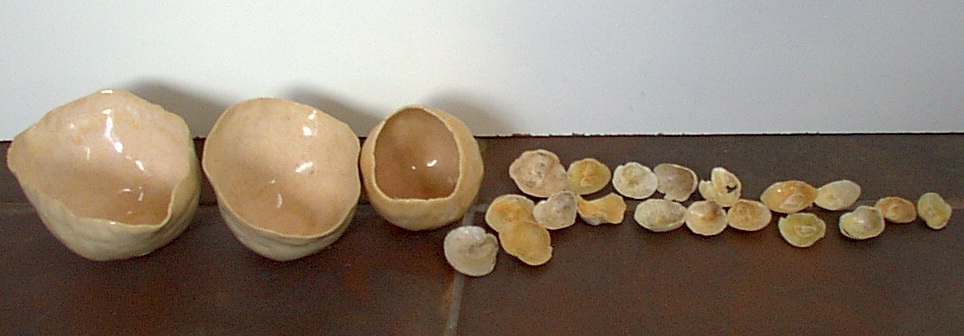 When I brought them home, I realized that the pinch pots I had been making in pottery class were oddly formed cups similar to the shells. By the way, I’ve been told that the creature that makes the shells is called anomia simplex.