
In April of 1965, I was in the village of Naoussa on the Island of Paros for Holy Week. We went there because a Greek friend (who spoke good English) would be visiting her brother, who was the doctor in the village. Naoussa was so small that if you heard an internal combustion engine you knew it was either the taxi or the truck. Soula and Andreas introduced us to Frankie, who was the rich man of the village. He had spent most of his life running a gas station in Chicago, and was now retired on $25 a month Social Security.
Friday night we were at Frankie’s house, having had supper we were playing a game of cards, when we heard what sounded like wailing coming from the street. We went out to see. Down the street came 2 priests in their vestments, carrying crosses. After them came a small group of men carrying a flower-covered coffin, and behind them all the villagers, dressed in black, carrying candles, and wailing. It was the coffin of Jesus Christ, but I understood immediately that it was also a chance to mourn for all the dear ones who had died that year and in years past too, a communal time of mourning for lost ones, lifted up into a larger loss.
Saturday night at midnight, our friends took us to the church, gave us red eggs and candles, and disappeared into the crowd. Bettie and I noticed some odd looks directed our way, and realized that we were on the men’s side of the church so we quickly relocated to the women’s side. The priests were up in front, behind a screen, we could hear them muttering. Suddenly they emerged, carrying lit candles, and shouting what sounded like “Christas anastas!” “Christ is risen!” They lit the candles of the people in the first pew who turned and lit the candles behind them, also shouting “Christas anastas!” The light flooded through the church, the people poured out the doors, shouting and singing. There was a bonfire just outside where we were told they were burning the body of Judas. We were quickly educated in the use of the red eggs (which were, by the way, a lovely soft brownish red). You banged them on your neighbor’s egg, and the one that broke lost. You could still use the other end, but eventually most eggs were losers and a few were winners. We never found out any more about what it meant. The people poured down the street to the taverna, where they ate and drank and sang and danced.
It was clear that the celebration had its roots in something far older than Christianity. I enjoyed the wildness, the drama, and the obvious fact that the emotions of mourning losses and celebrating resurrection were very real among the people.
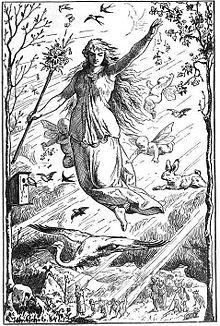
Just to make things clear about the older festival: our word “Easter” comes from “Eostre” the name of a Teutonic Goddess of Fertility. That’s where the word “estrogen” comes from, as well as all the eggs and bunnies.